Replays and analysis: seeing how students worked, not just what they scored
Two students with the same score can need completely different lessons. The replay is where you find out which lesson each one needs.
A score tells you how many questions a student got right. A replay tells you why the rest went wrong. Colorbook for Educators records how each student works each question, gives you a gradebook across the class, and adds Colorbook AI analysis on paid plans. This guide covers how to read each, in the order most teachers find useful.
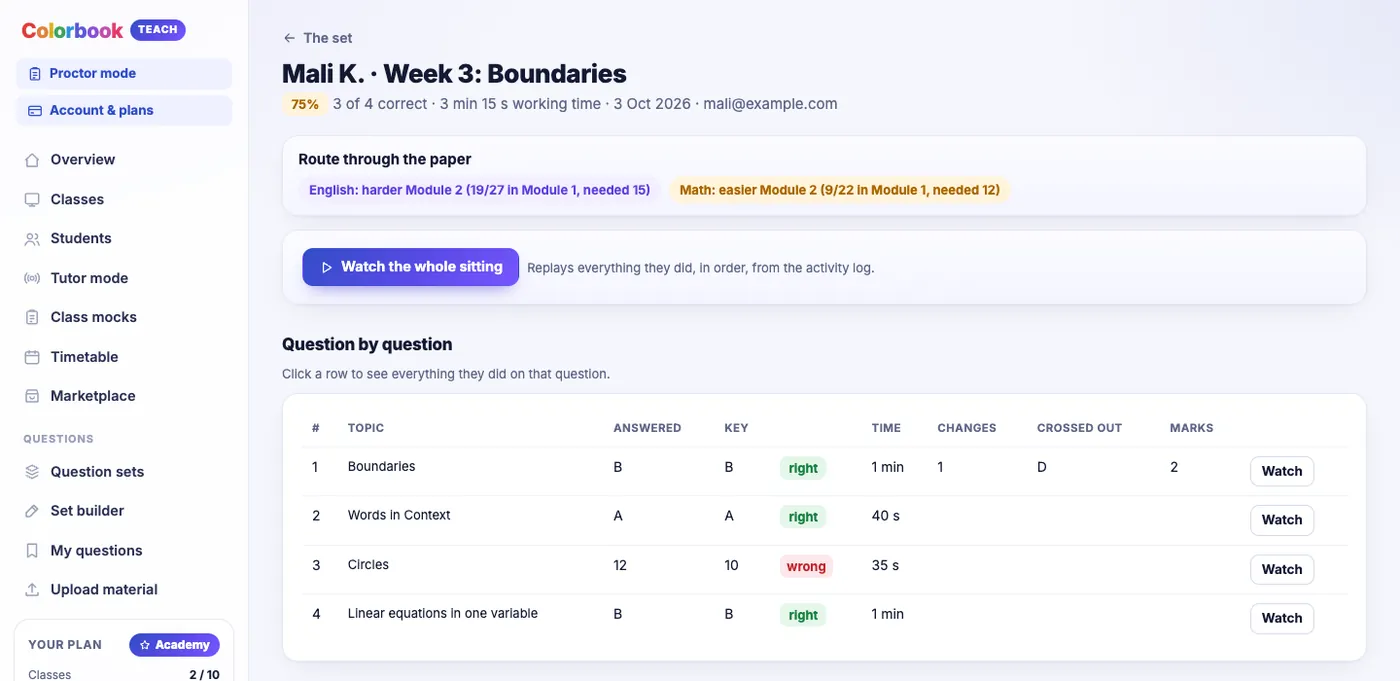
What a replay records
For every question, a replay shows:
- every answer change: which choice the student picked first, and every change after that;
- crossed-out choices: which options they eliminated, and when;
- highlights: what they marked in the passage or question;
- time per question: how long they spent on it.
Replays are available on every plan, including Free.
How to read a replay
Do not replay every question for every student; you will run out of time. Start from the gradebook, find the questions most of the class missed, and replay three or four students on each. Then look for these patterns.
Right, then changed to wrong
The student had it and talked themselves out of it. If this happens repeatedly, the issue is confidence or second-guessing, not knowledge. The lesson is about when to change an answer, not about the topic.
Crossed out the right answer
The student eliminated the correct choice early, usually because of a misreading. Look at what they highlighted: if they marked the wrong sentence in the passage, the problem is in how they read the question.
Very fast and wrong
A question answered in 15 seconds when the average is over a minute, and wrong, is usually a careless slip or a misread stem. Teaching the topic again will not fix it.
Very slow, right or wrong
Three minutes on a single question is a pacing problem whatever the outcome. Slow and right means the topic is known but insecure; slow and wrong means it is not known. A student who spent four minutes on question 7 and left the last three blank lost more than one mark on question 7.
No highlights on a Reading and Writing passage
Not every student needs to highlight, but a student who never does and keeps missing evidence-based questions may benefit from being taught to mark the claim before reading the choices.
The gradebook
The gradebook shows results across a class for every assigned set, and is available on every plan. Use it to answer two questions quickly: which students are falling behind, and which questions the whole class struggled with. A question missed by 18 of 25 students is a teaching problem; a question missed by 2 of 25 is a student problem. They need different responses.
Colorbook AI student analysis
Colorbook AI reads a student's work, including how they worked, and writes an analysis of where they are losing marks and what to work on. There are two levels:
- Standard analysis, included on Coach;
- Detailed analysis, included on Classroom and Academy.
The useful way to treat the analysis is as a second reader that has looked at every replay and is pointing you at patterns. Before acting on it, open two or three of the replays it refers to and check that you see the same thing. When it matches what you see, it has saved you an hour of replay-watching. When it does not, trust the replay.
Cohort analysis (Academy)
On Academy, Colorbook AI can also analyse a whole cohort: every student across a year group or a set of classes. This is for the questions a head of department asks: which topics are weak across the year, and whether one class is behind the others on something specific. It is most useful for planning the next block of teaching rather than for individual feedback.
Adaptive sets
Adaptive sets are picked from the Colorbook question bank based on each student's weakest topics, so practice goes where it is needed without you having to build the set by hand.
- Classroom includes 3 adaptive class sets a week, built for a class's weak topics.
- Academy includes those, plus 3 adaptive sets per student a week, built for each student individually.
A simple weekly rhythm on Classroom: one teacher-built set on this week's topic, plus the adaptive class sets for revision. On Academy, adding the per-student sets means a student who is strong on algebra but weak on data questions gets data questions, while their neighbour gets something else.
A 20-minute weekly review
- 5 minutes: gradebook. Note the two or three questions most of the class missed, and any student well below their usual score.
- 10 minutes: replays. Watch three students on each class-wide miss and sort what you see into the patterns above.
- 5 minutes: Colorbook AI analysis for the students you flagged. Check it against what you just watched.
That is enough to plan the next lesson around what actually went wrong.
What to watch for
- Do not read too much into one set. A single 15-question set is a small sample. Look for patterns across two or three before deciding a student has a particular weakness.
- Time is a clue, not a verdict. A long time on a question might mean struggle, or it might mean the student was interrupted at home. Look at the rest of the replay before deciding.
- Share replays with students. Watching their own replay with you, especially a right answer they changed, is often more convincing to a student than being told.
Questions teachers ask
- Are replays included on the Free plan?
- Yes. Replays and the gradebook are included on every plan, including Free.
- What is the difference between standard and detailed analysis?
- Coach includes a standard Colorbook AI analysis of each student's work. Classroom and Academy include a more detailed analysis. Academy also adds cohort analysis across many students.
- How are adaptive sets chosen?
- They are picked from the Colorbook question bank based on each student's weakest topics. Classroom includes 3 adaptive class sets a week; Academy also includes 3 adaptive sets per student a week.
- Should I rely on the AI analysis alone?
- Use it to find patterns quickly, then check two or three of the replays it refers to before acting. Where the two disagree, trust the replay.
See every answer change, crossed-out choice and highlight, and let Colorbook AI point you at the patterns.
See Colorbook for Educators